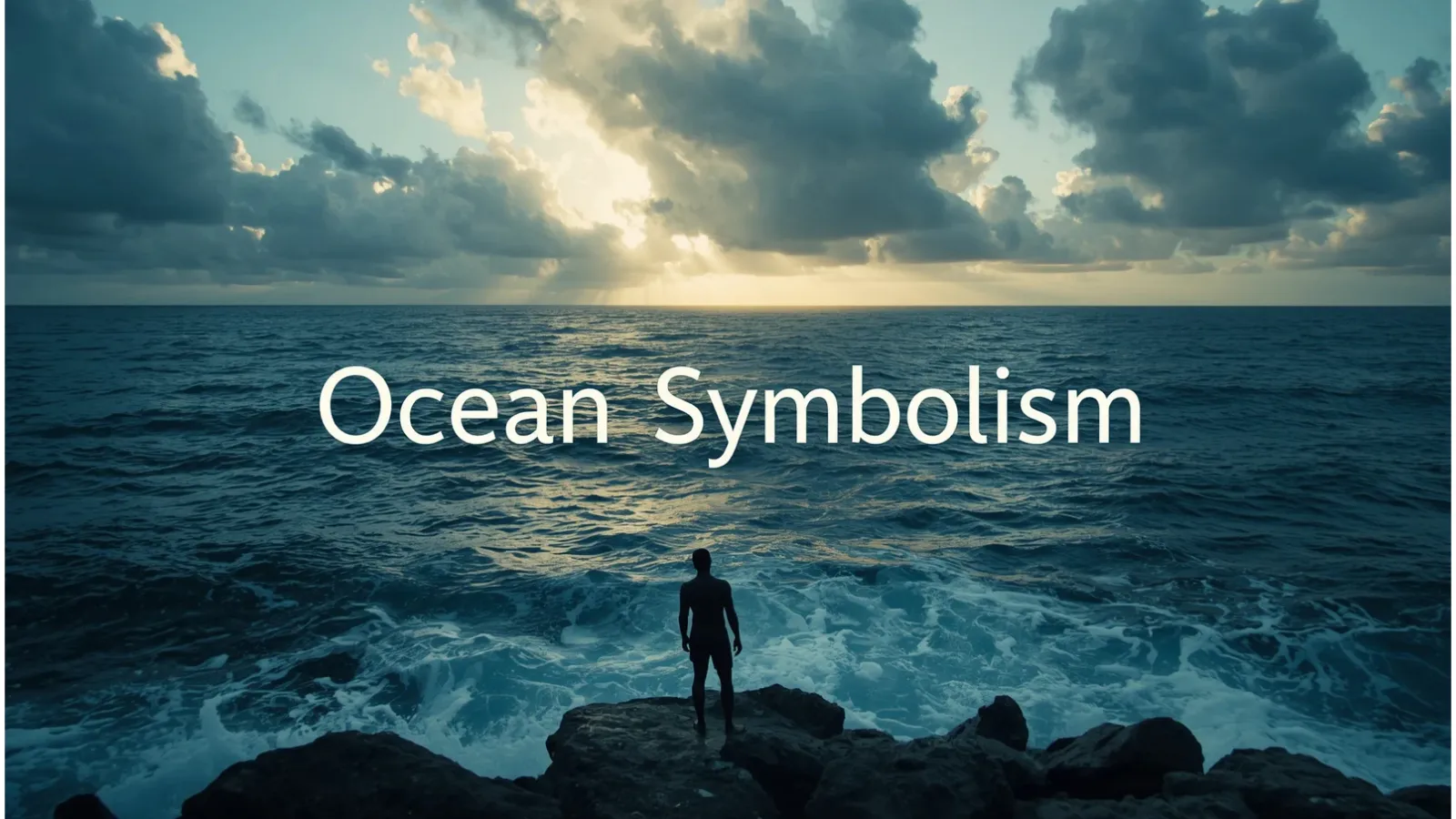
Imagine standing beside the ocean just before sunset. The waves move toward you, disappear, and return again. The water looks peaceful from the shore, yet you know there is a vast and mysterious world beneath its surface.
For centuries, people have looked at the ocean and seen more than water. It can represent freedom, mystery, emotional depth, transformation, healing, and the unknown. Its endless horizon can remind us that life is much bigger than one difficult moment.
The meaning of the ocean can also change depending on the story, culture, artwork, or personal experience. In one situation, it may symbolize peace. In another, it may represent fear, loneliness, or a journey into the unknown.
This guide explores ocean symbolism through literature, tarot, spirituality, life experiences, art, and tattoos. It also looks at how the ocean can reflect our deepest emotions and inner journeys.
Ocean Symbolism in Literature
In literature, the ocean often represents something much larger than the characters themselves. Writers use it to create a feeling of mystery, freedom, danger, longing, or transformation.
Because the ocean has no clear boundary from the viewpoint of a person standing on land, it can represent the unknown. A character who travels across the sea may also be beginning an emotional or personal journey.
The ocean can symbolize freedom because it is open and seemingly limitless. A character may look toward the water when they want to escape restrictions or imagine a different life.
At other times, the ocean represents danger. Storms, waves, shipwrecks, and deep water can reflect inner conflict or uncertainty.
The ocean can also represent memory. Like waves returning to the shore, memories may return again and again, even when someone tries to leave the past behind.
In poetry and fiction, the sea is often connected with:
- Freedom and escape
- Mystery and the unknown
- Emotional depth
- Adventure and discovery
- Loneliness
- Change and rebirth
- The boundary between the known and unknown
This makes the ocean a powerful literary image because its meaning can shift with the character’s emotional state.
King of Cups Tarot Card Throne Ocean Symbolism
The King of Cups tarot card often uses water imagery to express emotional wisdom, balance, compassion, and self-control.
In many traditional depictions, the king sits on a throne surrounded by water. The ocean or sea behind him can symbolize the deep emotional world that he has learned to understand without being controlled by it.
The water may be active, with waves, ships, or other details visible in the background. Yet the king himself remains seated and composed.
This creates an important contrast.
The water can represent powerful emotions, while the king represents the ability to remain steady while those emotions move around him.
The throne adds another layer. It can symbolize stability, authority, and emotional maturity. Together, the imagery can suggest that true emotional strength does not mean having no feelings. It means learning how to recognize and manage them.
From a symbolic perspective, the ocean behind the King of Cups may therefore suggest:
- Deep feelings
- Emotional intelligence
- Calmness during difficult moments
- Compassion
- Inner stability
- Acceptance of changing emotions
The image can be especially meaningful for someone learning to respond thoughtfully instead of reacting immediately.
Edna Pontellier Ocean Symbolism in Art
The ocean is particularly important in interpretations of Kate Chopin’s The Awakening, especially in relation to Edna Pontellier.
Throughout the novel, the sea becomes connected with freedom, awakening, identity, desire, and escape. Edna’s relationship with the ocean changes as she begins to question the expectations surrounding her life.
The sea can feel inviting because it represents a world beyond the social roles that restrict her. Its vastness gives her a sense of possibility.
Swimming also becomes symbolically important. The act of entering the water can be understood as a movement toward independence and self-discovery.
In visual art inspired by Edna’s story, artists may emphasize:
- The wide horizon
- A solitary figure near the water
- Open space
- Waves and movement
- Blue or dark tones
- The contrast between land and sea
These elements can communicate Edna’s complicated emotional experience.
Importantly, the ocean symbolism in The Awakening is not simply about happiness or freedom. It also carries isolation, danger, uncertainty, and tragedy. The same ocean that represents possibility can also represent an overwhelming force beyond human control.
That tension makes the imagery powerful.
Scorpio Water Sign and Deep Ocean Symbolism
Scorpio is traditionally associated with the water element in astrology, and the sign is often described through imagery of emotional depth, transformation, mystery, and intensity.
The comparison with the deep ocean is natural because the surface of the sea reveals only a small part of what exists underneath.
Symbolically, the deep ocean can represent the hidden emotional world associated with Scorpio themes. Feelings may exist beneath the surface even when they are not immediately visible.
The deep sea can therefore symbolize:
- Emotional depth
- Mystery
- Transformation
- Hidden truths
- Intuition
- Inner strength
- Emotional regeneration
A calm ocean surface can also hide powerful currents below. As a metaphor, this can describe someone whose outward appearance seems controlled while their inner world is rich and complex.
Astrology is a symbolic tradition rather than a scientific method for measuring personality. Within that symbolic framework, ocean imagery can help explain why Scorpio is frequently associated with emotional depth and transformation.
Ocean Symbolism in Literature
Across literature, the ocean can serve as both a setting and a symbol.
A journey across the sea can represent a character leaving one part of life and entering another. The shore can become a boundary between safety and uncertainty.
The ocean can also symbolize time. Waves continuously move forward and return, creating a natural image of repetition and change.
In stories about exploration, the sea often represents adventure. In stories about loss, it may represent separation. In romantic writing, it can express longing and emotional depth.
Writers may also use storms to represent emotional chaos. A peaceful sea can suggest inner calm, while rough waves can mirror fear, anger, grief, or confusion.
This flexibility is one reason the ocean appears so often in literary symbolism.
The same body of water can represent opposite ideas:
Freedom and confinement.
Peace and danger.
Beginning and ending.
Connection and separation.
The surrounding story determines which meaning becomes strongest.
Ocean Symbolism Spiritual
From a spiritual perspective, the ocean is often viewed as a symbol of infinity, emotional cleansing, mystery, and connection.
Its enormous size can make personal problems feel smaller. Standing beside the sea may encourage a person to pause and think about life from a wider perspective.
Water is also commonly connected with cleansing and renewal in many spiritual traditions. Because the ocean continually moves, it can become a symbol of releasing what no longer serves us.
The waves offer another meaningful image. A wave rises, reaches its highest point, and eventually returns to the sea. This natural rhythm can remind us that emotions also change.
Sadness can pass.
Fear can change.
Joy can return.
Life continues moving.
For someone going through a difficult period, the ocean may therefore become a personal symbol of healing and patience.
However, spiritual interpretations are personal. There is no single universal meaning that applies to every person or every encounter with the sea.
Ocean Symbolism in Life
In everyday life, the ocean can symbolize the journey we are all taking.
Sometimes life feels calm, like still water on a quiet morning. At other times, unexpected problems create waves that seem impossible to control.
The ocean teaches a useful metaphor: we cannot control every wave, but we can learn how to respond to changing conditions.
For someone starting a new career, moving to a new place, ending a relationship, or entering adulthood, the ocean may represent a new beginning.
For someone recovering from emotional pain, it may represent gradual healing.
For someone feeling trapped, its open horizon may represent freedom and possibility.
For someone who feels lost, its vastness may initially feel frightening but may eventually become a reminder that there are still many paths ahead.
Ocean symbolism in life can therefore be connected with:
- Growth
- Change
- Resilience
- Freedom
- Healing
- Adventure
- Emotional acceptance
- New beginnings
The important lesson is not that every difficult moment will disappear immediately. Instead, the ocean can remind us that life is always moving.
Ocean Symbolism Tattoo
An ocean tattoo can carry deeply personal meaning. Because the ocean has many symbolic associations, the design can represent different things for different people.
Waves are often chosen to represent strength, movement, resilience, and change.
A calm sea may symbolize peace and emotional balance. A stormy ocean can represent surviving a difficult chapter.
A lighthouse beside the sea can symbolize guidance through darkness. A compass and ocean combination can represent direction during an uncertain journey.
Some people choose a simple horizon line because it represents endless possibility. Others choose shells, boats, whales, moons, or sea creatures to add another personal layer.
Common symbolic ideas include:
- Wave — resilience and movement
- Calm sea — peace
- Stormy sea — surviving hardship
- Lighthouse — guidance
- Compass — direction
- Sailboat — adventure
- Horizon — possibility
- Deep ocean — mystery and emotional depth
The strongest tattoo meaning usually comes from the person’s own story rather than from a fixed symbolic dictionary.
Real-Life Scenarios
1. Standing by the Ocean After a Difficult Year
Imagine someone who has experienced several disappointments. They visit the beach alone and watch waves repeatedly reach the shore.
At first, the ocean reminds them of everything they have lost. Then they notice something simple: every wave arrives and leaves.
They begin thinking about their own life in the same way. Pain can arrive without staying forever.
For this person, the ocean may become a symbol of healing and resilience.
2. Watching the Sea Before a New Beginning
A young person stands beside the ocean before leaving home for a new opportunity.
The huge horizon feels both exciting and frightening.
There is no guarantee about what lies ahead, but the open water reminds them that the future has possibilities they cannot see yet.
Here, the ocean represents adventure, uncertainty, and personal growth.
3. Returning to a Childhood Beach
Someone returns to a beach they visited as a child. The landscape looks almost the same, but they have changed completely.
The waves remind them of childhood memories while also showing how quickly time moves.
The ocean becomes a bridge between the past and present.
For this person, it may symbolize memory, continuity, and change.
Frequently Asked Questions
What does the ocean symbolize?
The ocean can symbolize freedom, mystery, emotional depth, transformation, healing, and the unknown. Its meaning depends on the context.
What does the ocean symbolize spiritually?
Spiritually, the ocean may represent cleansing, renewal, emotional depth, infinity, connection, and the continuing movement of life.
Why is the ocean used as a symbol in literature?
Writers use the ocean because it can represent many powerful ideas, including freedom, danger, adventure, loneliness, emotional conflict, and the unknown.
What does a calm ocean symbolize?
A calm ocean often represents peace, emotional balance, acceptance, and inner stillness. However, the meaning can change depending on the surrounding story or artwork.
What does an ocean tattoo symbolize?
An ocean tattoo can represent resilience, freedom, healing, change, adventure, emotional depth, or a personal connection to the sea.
Conclusion
The ocean is powerful because it never has just one meaning. It can be peaceful and frightening, familiar and mysterious, comforting and overwhelming. Its waves remind us that nothing stays exactly the same.
In literature, it can become a doorway to the unknown. In tarot imagery, it can represent the deep world of emotions.
In spiritual reflection, it may suggest renewal and connection. In everyday life, it can become a reminder to keep moving through change. In art and tattoos, it can preserve a deeply personal memory or symbolize a new chapter.
Perhaps the most meaningful lesson is found in the waves themselves. They do not stop because the shore is difficult. They continue moving, returning, changing, and beginning again.
When you look at the ocean, you may see your own story reflected in it. Maybe you are searching for freedom. Maybe you are healing from something painful. Maybe you are standing at the edge of a new beginning.
Whatever your reason, the endless horizon can offer one gentle reminder: your current chapter is not the entire story.

Amelia Carter is a writer and symbolism researcher who explores the meanings people associate with everyday objects, colors, natural elements, and visual symbols. At Rankovistor, she focuses on making symbolism easy to understand while explaining how meanings can vary across cultures, traditions, and contexts. Her work covers topics ranging from colors and numbers to objects, nature, emotions, and common symbolic themes. Amelia takes a research-focused approach, separating widely recognized meanings from interpretations that depend on cultural or historical context. She enjoys turning complex symbolic ideas into clear, accessible explanations for curious readers. Through her articles, she helps readers discover the deeper meanings behind familiar symbols and understand how symbolism appears in everyday life, art, and culture.