Have you ever looked at a Greek symbol and felt that it meant more than just a beautiful shape or old story? Maybe you noticed a raven in Greek art, saw a pomegranate in a painting, or became curious about the symbols used in Greek mythology.
These images can feel mysterious because they often carry layers of history, emotion, faith, struggle, and transformation.
Greek culture gave the world many powerful stories about gods, heroes, nature, love, death, wisdom, and destiny. Because of this, Greek symbols are still used today in jewelry, tattoos, artwork, books, fashion, and spiritual reflection.
Understanding greek symbolism is not only about learning what an ancient object represented. It can also help us think about our own lives. A symbol may remind us of strength, rebirth, wisdom, love, or the courage to move through difficult change.
Let us explore some of the most meaningful Greek symbols and discover why these ancient images still speak to people today.
Ancient Greek Symbolism
Ancient Greek symbolism grew from religion, mythology, nature, art, and everyday life. Greeks used symbols to express ideas that were sometimes difficult to explain with ordinary words.
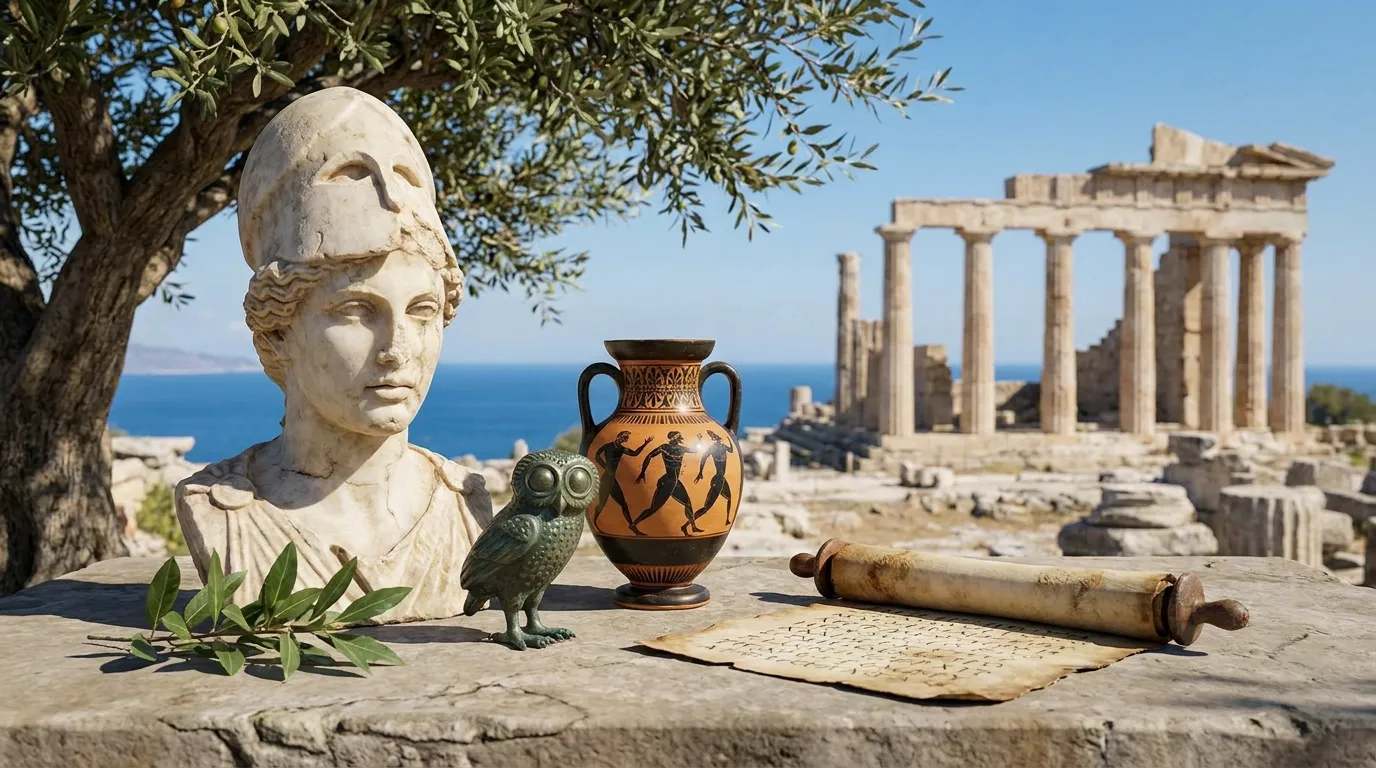
For example, the olive branch could represent peace and victory. The owl became closely connected with Athena and wisdom. The laurel was linked with Apollo and honor. The snake could represent healing, transformation, danger, or renewal depending on its context.
Many symbols were connected to particular gods and goddesses. Athena represented wisdom and strategic strength, while Aphrodite was associated with love and beauty. Zeus represented power and authority, and Demeter was strongly connected with agriculture, fertility, and the cycles of nature.
What makes these symbols especially interesting is that they often have more than one meaning. A symbol connected with death might also represent transformation. A symbol associated with war might also represent courage and protection.
This reminds us that life itself is rarely simple. Strength can grow from hardship, and new beginnings can emerge from endings.
Greek Symbolism Tattoo
Greek symbols have become popular tattoo choices because they can carry a personal message while also connecting the wearer with ancient history.
A Greek key, often called a meander, is one recognizable design. Its repeating pattern can suggest continuity, movement, and the endless nature of life. Some people choose it as a reminder that life continues through different stages.
Greek gods are another popular tattoo theme. Athena may represent wisdom and courage, while Apollo can symbolize creativity, light, knowledge, and artistic expression. Artemis may represent independence, nature, and protection.
The laurel wreath is also meaningful. In ancient Greece, laurel was associated with Apollo and with honor and achievement. A person choosing this design might use it to represent overcoming a difficult challenge or reaching an important goal.
A Greek tattoo does not have to be connected to a specific god. It can simply represent something meaningful in your own story.
Before choosing one, it is helpful to understand the original cultural and mythological context. A symbol becomes more powerful when you know the story behind it.
Raven Greek Symbolism
The raven has a complicated place in Greek mythology. It is often connected with Apollo and stories involving messages, prophecy, and consequences.
In one well-known myth, Apollo sent a white raven to watch over Coronis. The raven returned with troubling news, and the story became associated with punishment and change. Later traditions connected the raven with its dark appearance.
Because of these stories, raven symbolism can carry ideas such as messengers, hidden knowledge, warnings, prophecy, and transformation.
A raven may also represent the ability to observe carefully before making a decision. Birds can move between earth and sky, so they are sometimes viewed symbolically as creatures that connect ordinary life with a higher perspective.
However, the raven should not automatically be interpreted as a bad omen.
A dark bird appearing in a story may represent something difficult, but difficulty does not always mean disaster. Sometimes a warning can protect us. Sometimes an uncomfortable truth helps us grow.
If raven imagery repeatedly catches your attention, you might reflect on what you are currently being asked to notice. Is there something you have been ignoring? Is someone trying to tell you something important? Or do you simply need to step back and look at your situation from a wider perspective?
Pomegranate Greek Symbolism
The pomegranate is one of the strongest symbols in Greek mythology because of its connection with Persephone and the Underworld.
According to the myth, Persephone was taken to the Underworld by Hades. Her mother, Demeter, mourned her absence, and the earth suffered as a result. Eventually, an agreement allowed Persephone to return to the surface for part of the year.
But Persephone had eaten pomegranate seeds while in the Underworld. Because of this, she could not remain permanently in the world above.
This story became closely connected with the changing seasons.
The pomegranate therefore carries powerful ideas of life and death, separation and reunion, temptation, fertility, and transformation.
Its many seeds can also symbolize abundance and hidden potential. From the outside, a pomegranate looks simple. Inside, it contains many small pieces of life.
This can become a beautiful personal metaphor.
Sometimes our own potential is hidden beneath a difficult outer experience. A painful period may not reveal what is growing inside us. Yet with time, patience, and healing, something new can emerge.
The pomegranate can therefore remind us that endings are not always final. Some endings are part of a larger cycle.
Greek Mythology Symbolism
Greek mythology is filled with symbols that explore the deepest parts of human life.
The stories of Greek gods and heroes often involve love, jealousy, pride, courage, loss, revenge, wisdom, and transformation. This is one reason these stories remain popular thousands of years later.
The story of Icarus, for example, is often interpreted as a warning about overconfidence and ignoring limits. The story of Narcissus explores self-obsession. The journey of Odysseus can represent perseverance, survival, and the long road home.
Athena’s owl became associated with wisdom and thoughtful judgment. The olive tree can represent peace, abundance, and endurance. The laurel wreath can represent achievement and honor.
Greek mythology symbolism often teaches through stories rather than direct instructions.
Instead of saying, Do not become too proud, mythology may show a character whose pride causes suffering.
Instead of saying, Keep going when life becomes difficult, it may tell the story of a hero who survives years of trials before finally reaching home.
This makes mythology deeply emotional. We do not simply read about the characters. We recognize parts of ourselves in them.
Ancient Greek Symbolism
Ancient Greek symbolism can be understood through several major themes: nature, the gods, human behavior, life cycles, and the relationship between people and destiny.
The laurel can symbolize honor and achievement. The snake can represent healing and renewal, although its meaning changes depending on the story and context.
Greek architecture also contains symbolic forms. Columns, geometric patterns, and repeated designs were not simply decorative. They reflected ideas about balance, proportion, order, and beauty.
The sea, mountains, birds, plants, sunlight, and animals appeared repeatedly in myths.
A storm could become part of a divine story. A harvest could connect to a goddess. A tree could become a sign of protection or victory.
For modern readers, these stories can encourage a deeper relationship with nature and with our own emotions.
Mythology Symbolism and Meanings
A symbol can change depending on the story, character, culture, and situation.
For example, a snake can mean danger in one story and healing in another. Fire can represent destruction, but it can also represent knowledge, creativity, and transformation.
This is why it is better to ask, What does this symbol mean in this particular story? rather than assuming that every symbol has one universal meaning.
Some common themes include:
- Owl: wisdom, observation, thoughtful judgment
- Olive branch: peace, victory, reconciliation
- Laurel wreath: honor, achievement, recognition
- Pomegranate: fertility, life cycles, transformation, the connection between life and death
- Raven: messages, warning, hidden knowledge, change
- Snake: renewal, healing, transformation, danger
- Sun: light, life, clarity, power
- Sea: mystery, emotional depth, travel, uncertainty
- Wings: freedom, movement, ambition, spiritual elevation
- Labyrinth: confusion, inner searching, challenge, discovery
The deeper lesson is that symbols can become mirrors.
When we look at an ancient image, we may actually be looking at something inside ourselves.
A phoenix-like transformation can remind us that we can rebuild after hardship. A pomegranate can remind us that life moves through cycles.
This is why mythology continues to feel emotionally relevant in the modern world.
Real-Life Scenarios
Scenario 1: The Pomegranate at a Difficult Time
Emma was going through a major change in her life. She had recently left a situation that no longer felt healthy, but she was unsure about what would come next.
One day, she noticed pomegranate imagery repeatedly appearing in books, artwork, and social media posts.
Instead of treating it as a prediction, she used the symbol as a personal reminder. The pomegranate story helped her understand that life can move through seasons.
She began thinking of her current period not as the end of her story, but as a transition.
That thought gave her hope and patience.
Scenario 2: The Raven and an Important Decision
Daniel kept noticing raven images while deciding whether to make a major change in his career.
He became curious about their connection with Greek mythology and discovered stories linking ravens with Apollo and messages.
The symbol did not tell him what decision to make. Instead, it encouraged him to slow down and listen carefully.
He reviewed his choices, talked with people he trusted, and finally made a decision based on clearer information.
For Daniel, the raven became a symbol of awareness rather than fear.
Scenario 3: A Greek Tattoo After Personal Growth
Sophia wanted a tattoo after completing a difficult period in her life. She considered several Greek designs and eventually chose a laurel wreath.
For her, the wreath represented achievement and the ability to continue after setbacks.
Every time she looked at it, she remembered that she had already survived difficult days.
The tattoo became a quiet symbol of strength, resilience, and self-respect.
FAQs About Greek Symbolism
What is the main meaning of Greek symbolism?
Greek symbolism covers many ideas, including wisdom, courage, love, peace, transformation, death, rebirth, victory, and destiny. The exact meaning depends on the individual symbol and its mythological context.
What is the most famous Greek symbol?
There is no single symbol that represents all of Greek culture. The Greek key, olive branch, owl, laurel wreath, and symbols connected with Greek gods are among the best-known examples.
What does a pomegranate symbolize in Greek mythology?
The pomegranate is strongly connected with Persephone and the Underworld. It can represent fertility, life cycles, separation, return, transformation, and the relationship between life and death.
What does a raven symbolize in Greek mythology?
Ravens can be connected with Apollo, messages, observation, warnings, and consequences. Their meaning depends on the particular myth or artistic context.
Why are Greek symbols popular in tattoos?
Greek symbols combine visual beauty with stories and deeper meanings. People may choose them to represent wisdom, courage, achievement, transformation, protection, or an important personal experience.
Conclusion
Greek symbols have survived for centuries because they speak to experiences that humans still understand today. We still face uncertainty. We still experience love and loss. We still search for wisdom, courage, identity, and hope.
That is what makes greek symbolism so fascinating.
The raven can remind us to pay attention. The pomegranate can remind us that life moves through cycles. The olive branch can represent peace after conflict. The laurel can celebrate what we have overcome. The labyrinth can remind us that feeling lost does not mean we will never find our way.
Perhaps the greatest gift of symbolism is not giving us a fixed answer. It gives us a way to pause and reflect.
If a Greek symbol has caught your attention, take a moment to ask what it means to you. Maybe it represents something you are healing from. Maybe it reflects a dream you are chasing. Maybe it reminds you of someone you love. Or perhaps it simply gives you a new way to understand your own journey.
Symbols do not have to predict the future to be meaningful. Sometimes, they simply help us see the present with clearer eyes.
And sometimes, an ancient story can give a modern heart exactly what it needs: a little courage to keep moving forward.

Sophia Mitchell is a cultural symbolism writer specializing in mythology, folklore, traditional beliefs, and symbolic traditions from around the world. At Rankovistor, she explores Greek, Egyptian, Celtic, Chinese, Japanese, Aztec, and other cultural forms of symbolism. Her work examines the stories, figures, objects, creatures, and motifs that have carried symbolic meanings through different traditions. Sophia takes care to explain cultural context rather than treating a single interpretation as universal. Her articles are written for readers who want an accessible introduction to mythology and cultural symbolism while still understanding that meanings can change across time, regions, and traditions.