Have you ever noticed a myrtle plant and felt that there was something special about it? Its green leaves, delicate flowers, and sweet fragrance can make an ordinary garden feel peaceful.
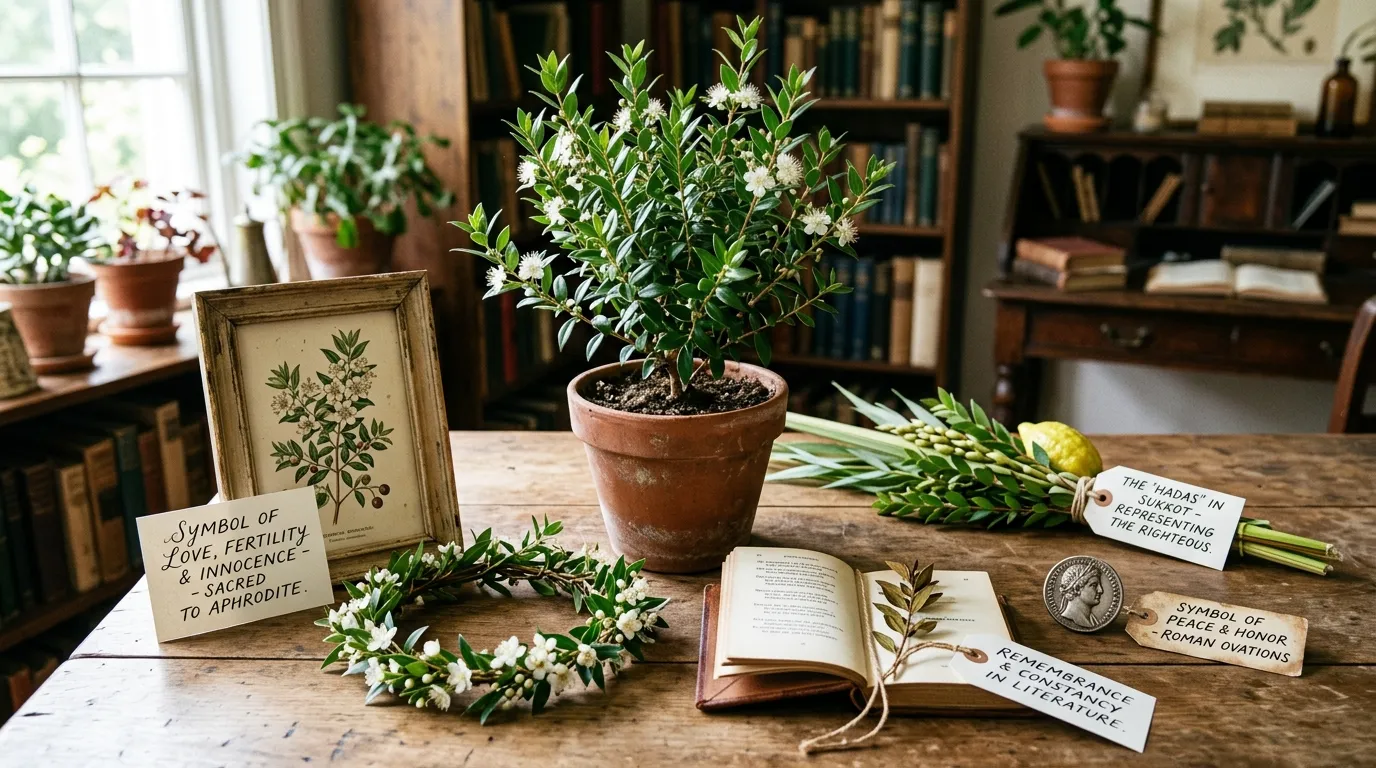
For centuries, myrtle has carried meanings connected with peace, love, renewal, hope, and restoration.
Different cultures and traditions have given this plant different meanings. In the Bible, myrtle appears as a picture of restoration and blessing. In Christianity, it can point toward hope and God’s care.
In literature, myrtle can take on a darker or more personal meaning. One famous example appears in The Great Gatsby, where Myrtle Wilson’s character is connected to ideas of desire, social class, and tragedy.
Understanding myrtle symbolism is not about finding one fixed meaning. The meaning can change depending on the culture, story, spiritual tradition, or personal experience surrounding it.
If you recently noticed myrtle, dreamed about it, or are simply curious about its deeper meaning, exploring its history can offer a beautiful way to reflect on peace, growth, and new beginnings.
Crepe Myrtle Symbolism
Crepe myrtle, also commonly written as crape myrtle, is known for its colorful flowers and long blooming season. Because it can continue flowering during warm months, people often connect it with beauty, endurance, renewal, and lasting joy.
The plant can symbolize the ability to keep growing even when conditions change. Its flowers may appear in shades such as pink, red, purple, and white, making it a popular ornamental plant.
Spiritually, crepe myrtle symbolism can be viewed as a reminder that beauty does not always arrive quickly. Sometimes growth takes time. A person may go through a quiet season before finally seeing signs of progress.
The plant can therefore represent:
- Renewal after a difficult period
- Hope during uncertain times
- Beauty that develops with patience
- Strength through changing seasons
- Joy after periods of waiting
- Growth that becomes visible over time
If you keep seeing crepe myrtles during a personal transition, you might use the image as a simple reminder to remain patient with your own growth.
Crape Myrtle Symbolism
Crape myrtle is simply another common spelling of crepe myrtle. Its symbolism is often connected with similar themes of beauty, persistence, love, and renewal.
One interesting feature of the plant is its ability to return with fresh growth after seasonal changes. This makes it an easy symbol for starting again.
Think about a tree or flowering plant during winter. It may appear quiet and lifeless, but that does not mean its story has ended. New growth can come when the season changes.
This can offer a meaningful spiritual lesson. A quiet period in your life does not necessarily mean that nothing is happening. Sometimes healing and preparation happen beneath the surface.
Crape myrtle can therefore encourage you to trust gradual change. You may not see the final result today, but small steps can still matter.
Its symbolism may be especially meaningful when you are:
- Beginning a new chapter
- Recovering from disappointment
- Waiting for an important change
- Learning patience
- Rebuilding confidence
- Looking for hope and emotional renewal
Myrtle Symbolism in The Great Gatsby
Myrtle symbolism in The Great Gatsby is very different from the peaceful meanings often associated with the plant itself. In F. Scott Fitzgerald’s novel, Myrtle Wilson is a major character whose life is connected with desire, social ambition, wealth, and tragedy.
Myrtle Wilson is married to George Wilson, but she has an affair with Tom Buchanan. She wants to escape her working-class life and enter the wealthy world represented by Tom.
Her character can therefore be discussed through themes such as desire, dissatisfaction, social class, illusion, and longing.
Myrtle believes that becoming connected to wealth will help her become someone different. Her apartment in New York becomes a temporary space where she tries to act as though she belongs to a higher social class.
This creates an important contrast. The name Myrtle can carry peaceful natural associations, while Myrtle Wilson’s story becomes increasingly painful and destructive.
Her tragedy also reveals one of the novel’s larger ideas: chasing an idealized life can have serious consequences when reality is ignored.
It is important to distinguish literary symbolism from traditional plant symbolism. Fitzgerald’s use of the name does not mean that the myrtle plant itself traditionally represents everything Myrtle Wilson represents. The literary meaning comes from the character and her role within the novel.
Myrtle Symbolism Bible
Myrtle has a meaningful place in biblical imagery, especially in passages connected with restoration and God’s blessing.
One important reference appears in Isaiah 41:19, where the myrtle is included among plants that God will provide in a transformed landscape. Another significant passage appears in Isaiah 55:13, where the myrtle is contrasted with the thorn as part of a picture of restoration.
These passages give the plant a strong connection with renewal and restoration.
In biblical imagery, a barren or difficult landscape being transformed into a place filled with healthy plants can represent God’s ability to bring life where there once seemed to be little hope.
This makes myrtle a meaningful symbol for people thinking about spiritual renewal.
The message can be understood simply:
A difficult season does not have to be the final chapter.
The biblical image of the myrtle can remind readers that restoration can replace hardship and that new life can emerge where people least expect it.
Myrtle Symbolism Spiritual
From a spiritual perspective, myrtle can represent peace, healing, love, renewal, and hope.
Its green leaves may remind people of continuing life, while its flowers can suggest beauty appearing at the right time. Its fragrance can also create associations with memories, comfort, and emotional warmth.
Some spiritual interpretations connect myrtle with:
- Peace after emotional conflict
- Healing after pain
- Love and faithful relationships
- Renewal after an ending
- Hope during uncertainty
- Protection in some cultural traditions
- Growth through patience
However, spiritual symbolism is interpretive rather than a universal rule. Seeing a myrtle plant does not automatically predict a specific event.
Instead, you can use its symbolism as a personal reflection tool. Ask yourself what the plant brings to mind. Are you entering a new season? Are you healing from something? Are you trying to create more peace in your life?
Sometimes the value of symbolism comes from helping us notice feelings we have been too busy to recognize.
Myrtle Symbolism in the Bible
Myrtle appears in several biblical passages, particularly in the Old Testament.
In Isaiah 55:13, the myrtle is part of an image of transformation. The passage describes a change from thorn-producing ground to something more beautiful and life-giving.
This image is powerful because thorns can represent difficulty, while a living plant can represent restoration and blessing.
Myrtle also appears in Zechariah 1:8, where the prophet describes a vision involving a man among myrtle trees. The setting gives the plant a place within a prophetic scene.
These biblical references have helped make myrtle a symbol associated with God’s presence, restoration, peace, and hope in later interpretation.
For a Christian reader, the most comforting idea may be restoration. The myrtle can remind you that circumstances can change and that a season of struggle does not have to define your entire life.
Myrtle Symbolism Christianity
In Christianity, myrtle can be understood through the broader biblical themes of renewal, peace, restoration, and God’s faithfulness.
It is not one of the central symbols of Christianity in the same way that the cross, bread, wine, or dove are. Still, its biblical appearances allow Christians to reflect on God’s promise of renewal.
The plant can become a simple reminder of spiritual growth.
A Christian might see its symbolism as encouragement to:
- Remain hopeful during difficult seasons
- Trust God’s timing
- Seek peace instead of conflict
- Allow spiritual growth to take time
- Remember that restoration is possible
- Stay rooted in faith
The deeper lesson is not that the plant has supernatural power. Rather, its biblical imagery can help someone reflect on themes already present in Scripture.
Myrtle Symbolism in The Great Gatsby
The literary meaning of Myrtle in The Great Gatsby becomes clearer when we look at her relationship with wealth and identity.
Myrtle Wilson wants a life that looks very different from the one she has. She associates wealth with freedom and status. Her relationship with Tom gives her temporary access to that world, but it cannot provide the lasting transformation she desires.
Her story exposes the gap between appearance and reality.
She changes her behavior when she enters the city apartment. She dresses differently, speaks differently, and tries to behave as if she belongs to a wealthy social group.
Yet the social world she wants to enter remains controlled by powerful people like Tom.
Her death is one of the novel’s major tragedies. It also contributes to Fitzgerald’s criticism of a society in which wealth, privilege, desire, and carelessness can have devastating consequences.
Therefore, when discussing myrtle symbolism in The Great Gatsby, it is useful to focus on Myrtle Wilson as a literary character rather than treating her as a direct representation of the traditional symbolism of the myrtle plant.
The contrast itself is interesting: a name associated with natural beauty and renewal belongs to a character whose story ends in violence and loss.
3 Real-Life Scenarios
Scenario 1: Seeing Myrtle During a Difficult Season
Imagine someone has recently experienced a painful breakup. While walking through a garden, they notice a flowering myrtle for the first time.
The plant does not magically predict a new relationship. But its traditional associations with peace and renewal may give that person a helpful thought:
Healing can take time, and life can become beautiful again.
Scenario 2: Myrtle During a New Beginning
Someone moves to a new city and feels nervous about starting over. They notice a crepe myrtle blooming near their new home.
They may interpret it as a personal reminder of growth and fresh beginnings.
The symbolism can encourage them to focus on what they can build instead of constantly looking back.
Scenario 3: Finding Myrtle While Studying the Bible
A person reading Isaiah discovers the references to myrtle and becomes curious about the plant.
They learn that myrtle appears in biblical images of restoration. That idea may become meaningful during a difficult period in their life.
Rather than treating the plant as a prediction, they use the biblical image as a reminder that difficult seasons can change.
Frequently Asked Questions
What does myrtle symbolize spiritually?
Myrtle can symbolize peace, renewal, love, restoration, hope, and growth. Its meaning can vary depending on cultural and spiritual context.
What does myrtle symbolize in the Bible?
In biblical passages, myrtle is associated with imagery of restoration and renewed life. Isaiah uses the myrtle in descriptions of transformed landscapes and blessing.
What does myrtle symbolize in Christianity?
Christian interpretations often connect myrtle with biblical themes such as restoration, peace, hope, and spiritual renewal. It is not considered one of Christianity’s primary symbols.
What does Myrtle symbolize in The Great Gatsby?
Myrtle Wilson represents themes including desire, social ambition, class divisions, illusion, and tragedy. Her literary meaning comes from Fitzgerald’s characterization rather than traditional plant symbolism.
Is seeing a myrtle plant a spiritual sign?
Some people may personally interpret seeing a myrtle plant as a reminder of hope, peace, or renewal. However, there is no universal rule that seeing one predicts a particular spiritual or future event.
Conclusion
Myrtle carries a fascinating mixture of meanings. In nature, it can bring thoughts of beauty, growth, fragrance, and renewal.
In the Bible, it appears within powerful images of restoration. In Christian reflection, it can point toward hope, peace, and God’s faithfulness. In The Great Gatsby, the name becomes part of a very different story involving desire, social class, illusion, and tragedy.
This difference teaches us something important about symbolism itself. A symbol does not always have one permanent meaning. Its meaning can change with the story, culture, faith, and personal experience surrounding it.
If a myrtle plant has caught your attention recently, perhaps let it remind you of something simple: growth can happen quietly. A difficult season may not be the end of your story. Like a plant that waits for the right season to bloom, you may also be moving toward a time of greater peace, healing, and renewal.
You do not have to understand every part of your journey today. Sometimes it is enough to keep growing, keep hoping, and allow the next season to arrive in its own time.

Ethan Brooks is an animal symbolism writer who researches the meanings associated with birds, mammals, insects, reptiles, and other creatures. His work at Rankovistor explores how animals have been represented in folklore, mythology, literature, art, and cultural traditions. Ethan covers both familiar animals and unusual creatures, helping readers understand why particular animals have become associated with qualities such as strength, freedom, wisdom, transformation, protection, or mystery. His writing emphasizes context because animal symbolism can differ significantly between cultures and traditions. Ethan’s goal is to provide clear, informative explanations while distinguishing established cultural associations from modern interpretations.